How to trade meme coins without losing your deposit on the first miss
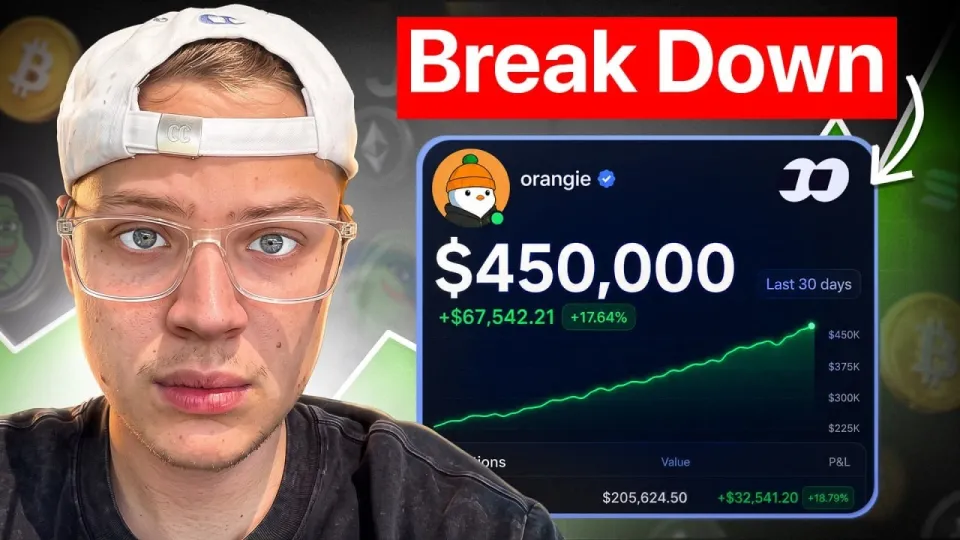
Video: How I Made $450,000 Trading Memecoins in 30 Days
Need articles like this for your video? They help promote it on YouTube and Google — order them in the Telegram bot @sat_sit_bot. Articles with your video embedded are written and posted by the bot itself — on popular topical sites (no ads). Try it free: 50 articles on us.
· based on the channel Orangie Web3
Meme coins are tokens with no cash flow, no product and no roadmap that survive purely on attention, so trading them is a bet on narrative flow rather than on fundamentals. The practical answer is to treat them as a lottery portfolio: size every position so a total loss is survivable, verify liquidity and holder distribution before buying, and plan the exit before the entry. Orangie Web3 walks through his own version of this in the video "How I Made $450,000 Trading Memecoins in 30 Days", and the paid community he points viewers to is the Kaizen group, available via the Whop checkout page.
What a meme coin actually is and why the numbers look absurd
A meme coin is a token whose price is set entirely by supply and demand for the joke, the mascot or the moment, not by revenue. Dogecoin is the original example, but the current cycle's action is on Solana, where launchpads let anyone mint a token in seconds and a bonding curve pushes it onto a decentralised exchange once a market cap threshold is hit. That structure explains both the upside and the trap: a token can go from a few thousand dollars of market cap to tens of millions in hours, and it can also be abandoned by its creator in the same window. When you see a headline number like $450,000 in 30 days, the honest framing is that it is the sum of a small number of outsized winners minus a much larger number of small losses, and the winners are usually identified after the fact.
Position sizing rules that keep you in the game
The first rule of meme coin trading is that no single trade should be able to end your account. Because the distribution of outcomes is extremely skewed, a fixed-fraction approach beats conviction-based sizing: if you risk 2-5% of your bankroll per token, you can absorb twenty consecutive losses and still have capital for the trade that matters. Traders who put 30-50% into one launch usually exit the niche after one rug, and their experience is exactly what shows up in the comments under these videos, where viewers describe losing most of a small deposit on their first attempts.
A workable sequence looks like this:
- Fix a total bankroll you are willing to lose entirely and keep it in a separate wallet from your long-term holdings.
- Split that bankroll into 20-40 equal tickets so each token gets the same small stake.
- Take partial profits on the way up instead of waiting for a target that may never print.
- Recycle only realised profit into larger tickets, never the original stake.
- Stop for the day after a set number of losses; tilt is the most expensive emotion in this market.
How to check a Solana meme coin before you buy
Due diligence on a meme coin takes about two minutes and filters out most of the obvious traps. Start with liquidity: a pool under roughly $30,000-50,000 can be moved violently by a single seller, and if the liquidity is not locked or burned, the deployer can pull it. Next, look at holder concentration, because a wallet holding 10% or more of supply can dump on you at any moment, and check whether the top holders are fresh wallets funded from the same source, which usually means one entity. Then check the contract for mint authority and freeze authority, both of which should be revoked, and look at the age of the token: a launch that is ten minutes old and already up 40x is a worse risk-reward than one that has survived a few hours of selling. Finally, read the narrative, because meme coins run on a story that a stranger can understand in one sentence; if you cannot explain the joke to someone in a chat, the token has no distribution engine behind it.
Entry, exit and the psychology of a 10x
Entry logic in meme coins is about asymmetry, not accuracy. Buying a token that has already run 20x means your downside and upside are roughly symmetric, while buying early on a token with a real narrative and thin liquidity gives you a chance at a 5-10x for a 100% loss. That is why experienced traders talk about "one hit" carrying a whole month: a $2,000 position that goes to $20,000 pays for ten total losses of the same size. The exit side is harder. Scaling out in thirds, taking the initial stake off at 2x and letting the rest run with a trailing stop, converts a lucky trade into a realised gain instead of a screenshot. Viewers of Orangie Web3 repeatedly ask for exactly this breakdown, wanting the reasoning behind the entry and the exit rather than the outcome, and it is the most transferable part of any trading video.
The community question: skill, group calls or luck
The most common scepticism about large meme coin profits is that they come from private groups sharing calls rather than from individual analysis. That criticism has a real basis: paid and free trading communities do coordinate, and members who see a call early have an edge over someone watching a chart afterwards. The realistic response is not to dismiss the results but to separate what you can copy from what you cannot. You can copy risk limits, liquidity checks, exit discipline and record-keeping; you cannot copy being in the right Discord at the right second. Treat any call, including one from a paid group such as the one linked from the video, as a research lead rather than a signal, and assume you are the last person in the queue.
Where meme coin trading usually goes wrong
The failure mode is almost never a single bad pick; it is a sequence of small process errors that compound. Buying without checking whether liquidity is locked, averaging down into a token whose narrative has already died, holding a position because the community is enthusiastic, and increasing size after a win are the four habits that turn a profitable month into a flat year. A simpler discipline is to write down the thesis for every trade in one line before entering, and to close the position when the thesis breaks rather than when the price does. That single habit makes the difference between a trader who survives a full cycle and one who donates a deposit to the market.
Useful links
- Kaizen group access via Whop: https://whop.com/checkout/plan_GTFkEFh0JFpU8?a=orangie
- FOMO trading platform referral: https://fomo.family/r/orangie
- Orangie's Discord community: https://discord.gg/memecoins
- Instagram: https://www.instagram.com/orangieyt/
Final thoughts
Meme coin trading is a legitimate high-risk strategy, but the returns in headline videos are the tail of a distribution, not an expectation. What is actually repeatable is the process: small fixed tickets, two minutes of on-chain checks, partial exits, and a written thesis for every position. Orangie Web3's breakdown is useful precisely because it shows the trade-by-trade mechanics behind a large number, and the Kaizen group linked in the video is where he routes viewers who want that level of detail. If you take one thing from it, take the sizing rule, because it is the only part that protects you when the next launch goes to zero. Start with the Whop checkout page only after you have decided how much you can afford to lose entirely.
Key takeaways
- Meme coins are a high-variance game: a single winner can cover a long series of losing trades, which is why position sizing matters more than picking.
- Orangie Web3's video title claims $450,000 in 30 days of meme coin trading, and the access point promoted in it is the Kaizen group on Whop.
- Most meme coin volume in 2026 runs on Solana launchpads, where liquidity can be pulled within minutes of a token going live.
- A 90% drawdown on one position is normal in this niche; recovery math requires roughly a 10x on what is left.
- The trader's own community feedback in the comments is that entry, exit and coin selection reasoning matter more than speed of execution.
Source: How I Made $450,000 Trading Memecoins in 30 Days · Markdown version
Questions & answers
How much money do you need to start trading meme coins?
You can start with a very small amount, but the size of your bankroll determines whether the strategy is viable. With $100 you should expect to lose it while learning, because fees, slippage and failed launches eat small accounts quickly. A more practical starting point is an amount you can lose without changing your finances, split into 20 or more tickets.
Is it realistic to make $450,000 in 30 days from meme coins?
It is possible but statistically rare, and it usually requires a combination of early access, large position sizes and at least one extreme winner. The same approach produces many accounts that end the month down 80-90%. Treat published results as a description of the tail outcome, not as a target return.
What is the fastest way to spot a rug pull before buying?
Check whether liquidity is locked or burned, whether mint and freeze authority are revoked, and how concentrated the holder list is. A single wallet holding more than 10% of supply, or several wallets funded from the same address, is a strong warning. If the pool is under roughly $30,000, assume you may not be able to exit at the price you see.
Should I follow calls from trading groups and Discords?
Use them as research leads, not as entry signals. By the time a call reaches a public channel, the earliest members have often already bought, which means you are providing exit liquidity. Verify the token yourself with the same liquidity and holder checks you would apply to any other launch.